

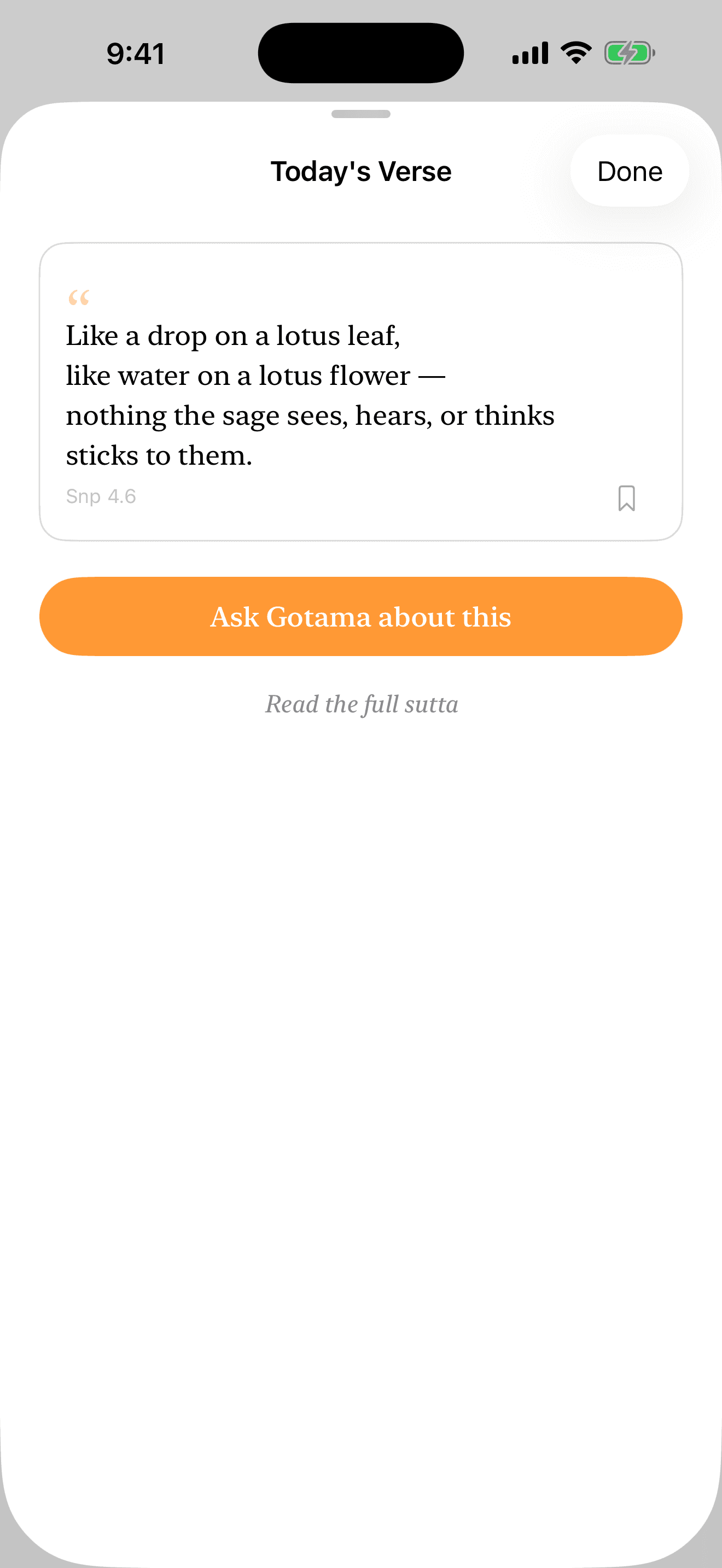
Like a drop on a lotus leaf,
like water on a lotus flower —
nothing the sage sees, hears, or thinks
sticks to them.
Jarāsutta · Snp 4.6
From the Atthakavagga — among the Buddha's earliest preserved teachings, before two thousand years of commentary.
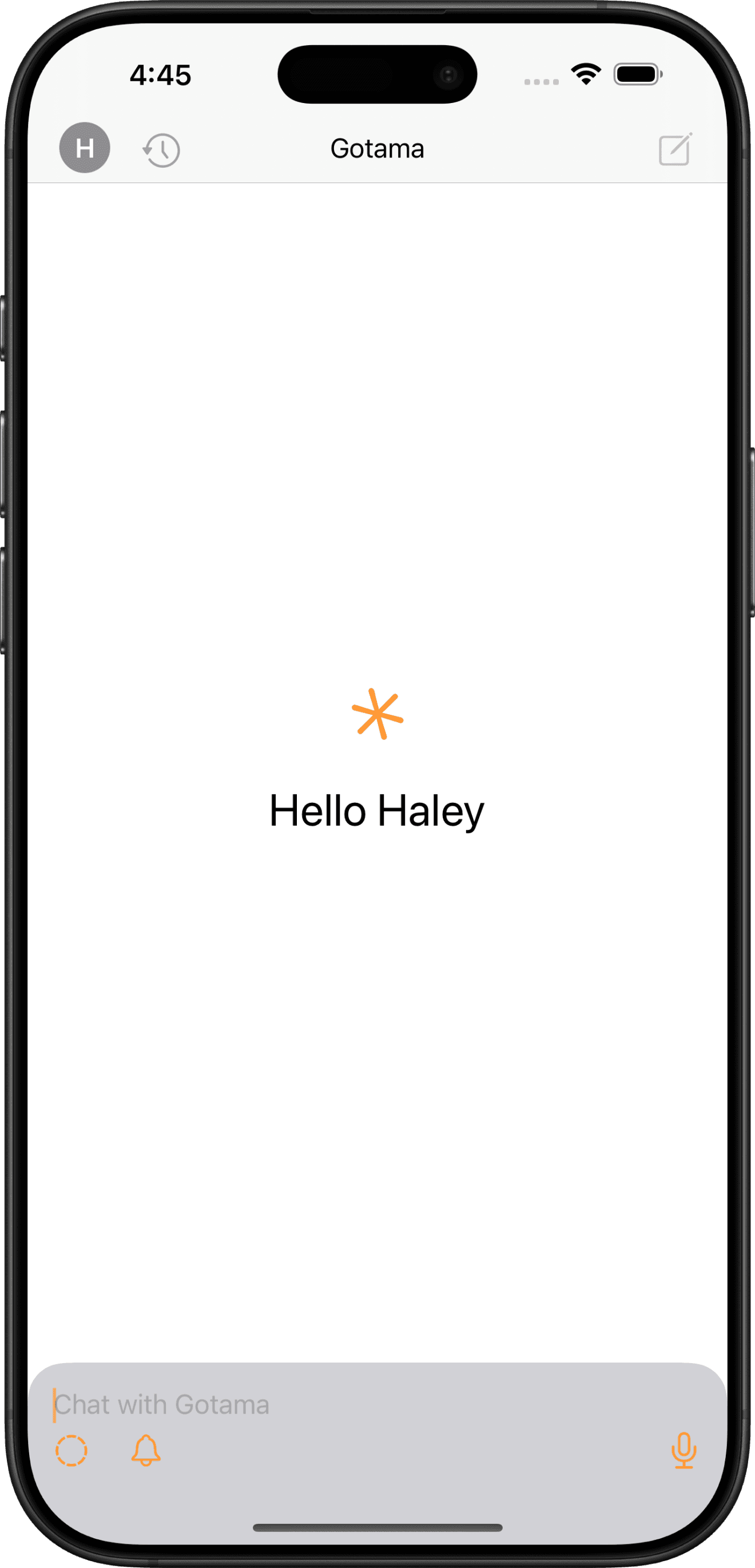
A verse each morning, to bring into conversation.
Each morning brings a verse from the early canon. Tap it to ask Gotama what it means for your day, or read the full sutta it comes from.
Save the ones that stay with you.
Meet Gotama
Before he became famous as the Buddha, people just called him Gotama.
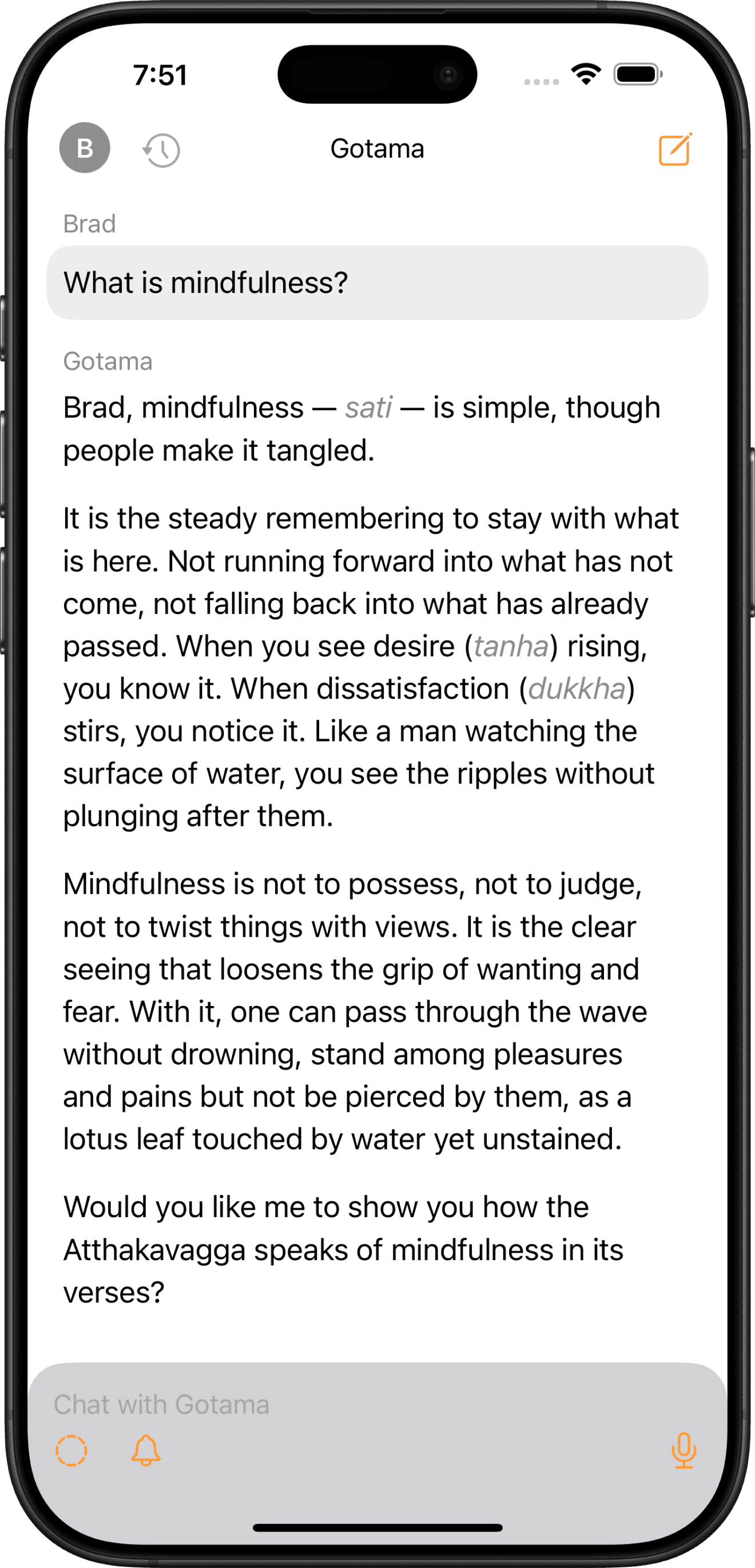
Meet Gotama, an AI based on the earliest Buddhist verses.
The Library
Not pulled toward the future,not grieving the past,alone amid the senses,not led around by views.
The Aṭṭhakavagga, in modern English.
All sixteen suttas in modern English, with the Pāli source one tap away. Per-sutta translator's reference notes for the curious reader.
The same texts the iOS app draws from. No login, no app, no paywall.
Open the libraryWhy Gotama
Three choices that make this app different from generic mindfulness.
Primary text.
Conversations are grounded in the sixteen suttas of the Atthakavagga — among the Buddha's earliest preserved teachings, memorized by new monks and passed down for two thousand years before any commentary was written.
Plain English.
Translations meet you where you are. No prior knowledge of Pali or Buddhist terminology is required. We work from the original texts with the goal of readability, not technical correctness.
Conversational.
Bring what's weighing on you. Gotama responds with grounded reflections and verses from the original text — not a lecture. The aim is what the Buddha himself called ehipassiko: come and see. Test the ideas against your own experience.
The Atthakavagga is often recommended to advanced students by teachers like Joseph Goldstein, Bhikkhu Anālayo, and Gil Fronsdal. The translations and framing here draw on modern scholarship — Norman, Bodhi, Fronsdal, Lee — with receipts in the bibliography below.
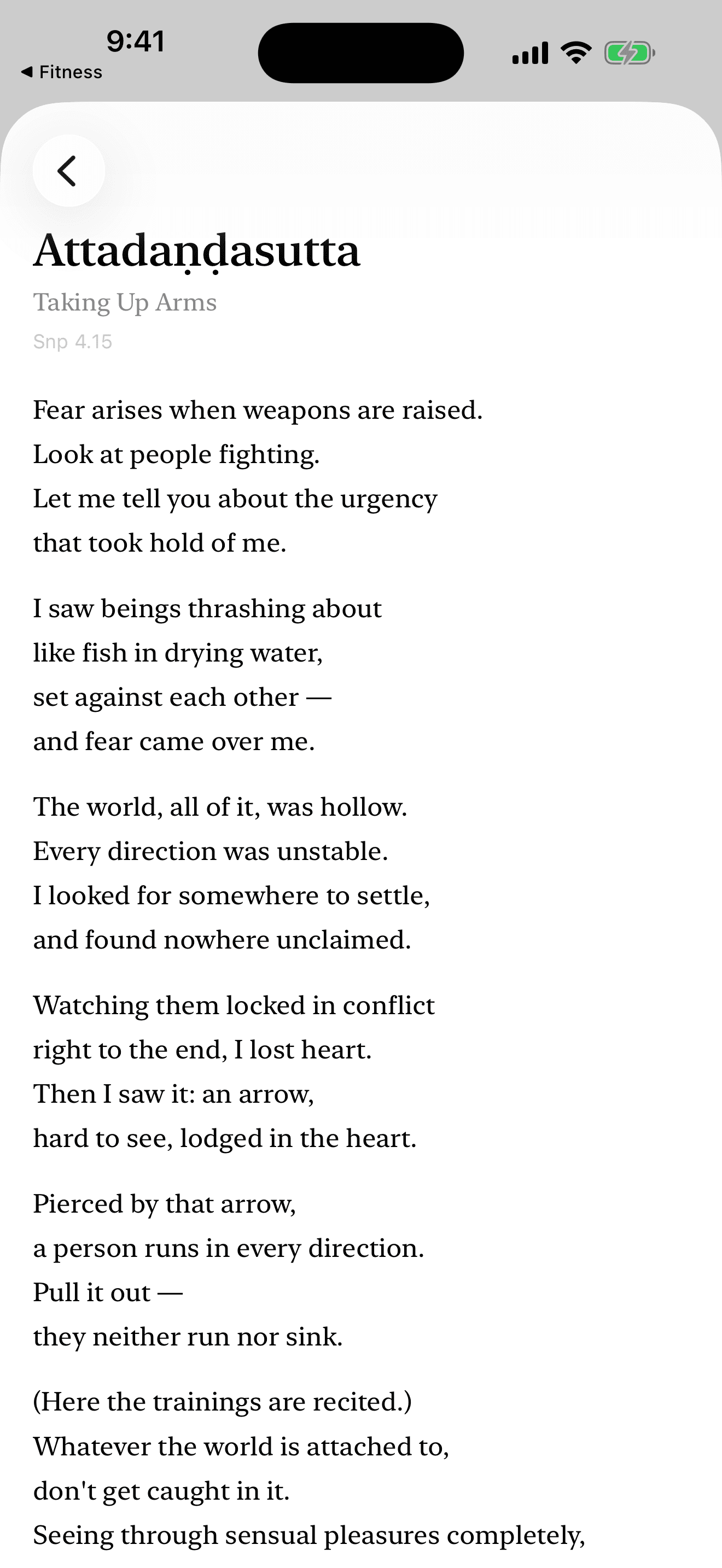
Read the verses.
The sixteen suttas of the Atthakavagga — Kāmasutta, Jarāsutta, Attadaṇḍasutta, and the rest — are readable in the app, in serif.
Tap “Ask Gotama about this” on any sutta to bring it into a conversation. The text and the chat are one continuous practice.
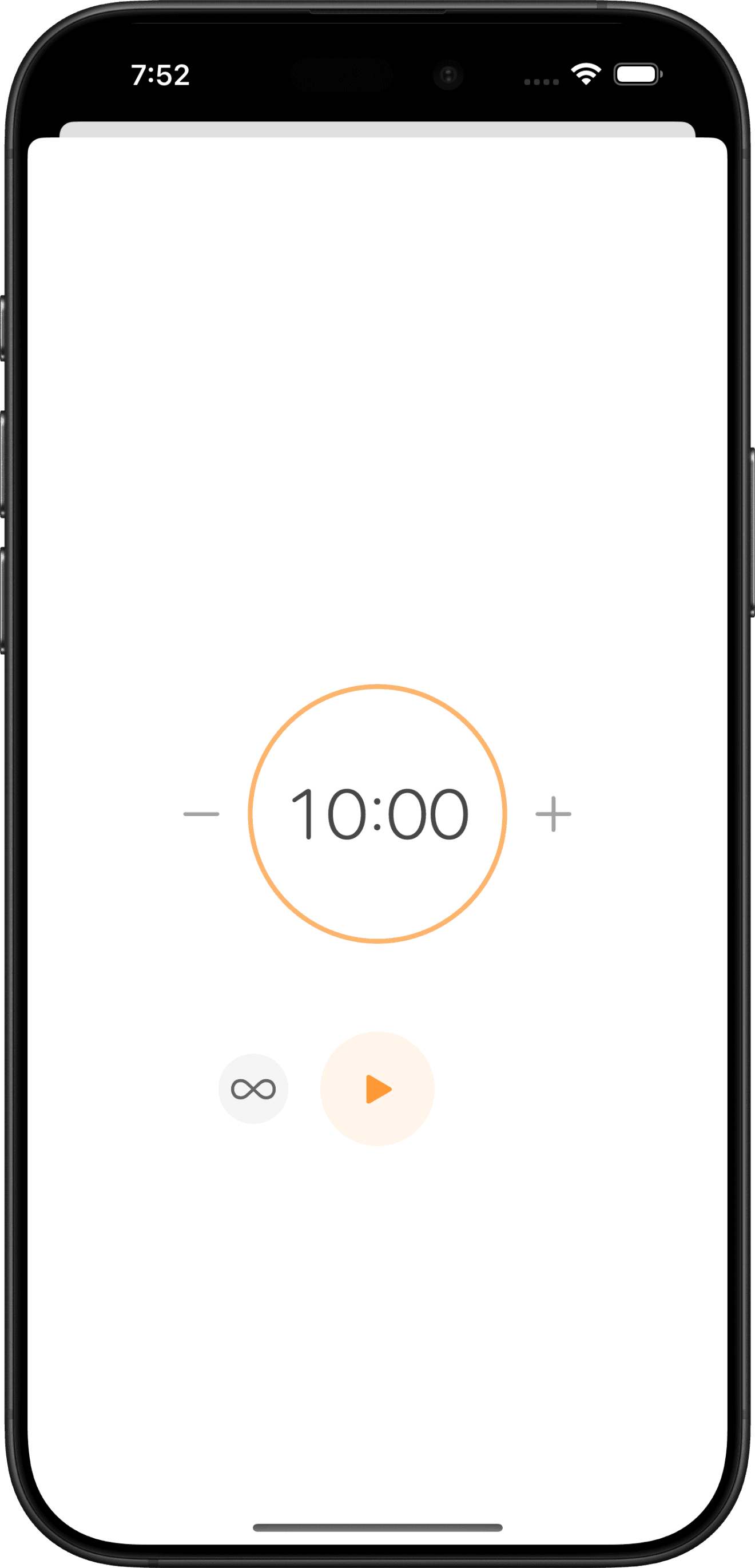
Sit with intention.
A simple meditation timer for when you want to sit. Ask Gotama a question first if you're unsure where to begin, then sit with what comes up.
No badges, no guilt. The practice is its own reward.
Pause through the day.
Schedule gentle bells — every hour, or on whatever rhythm fits your day. A few seconds of sound, a small reminder to come back to where you actually are.
Most of the practice happens outside the cushion. The bells are for the rest of the day.
Chat with Gotama for free.
A free tier with daily message limits. Subscribe to remove the limits and keep the free version available for everyone.
Bibliography
Key works on early Buddhism and the Atthakavagga consulted in the development of Gotama.
Modern translations
Scholarship
Common questions
Answers about free messages, pricing, scholarships, and how Gotama AI works.
What is the Atthakavagga?
The Atthakavagga ("Chapter of Eights") is the fourth book of the Sutta Nipāta — among the earliest preserved Buddhist verses. Gotama draws on all sixteen suttas of the Atthakavagga — among the Buddha's earliest preserved teachings, before two thousand years of commentary built up around the texts.
How is this different from Calm or Headspace?
Calm and Headspace teach modern, secular mindfulness — they don't draw on a specific source text. Gotama is conversational and grounded in primary Buddhist verses; the focus is on engaging with the material directly rather than learning a curriculum. If you've graduated from secular mindfulness and want to engage with the source, Gotama is for you.
Do I have to be Buddhist to use it?
No. These verses speak to anyone who senses life's restlessness. The focus is on insight, not belief — what the Buddha himself called ehipassiko, "come and see." Test the ideas against your own experience.
How are the translations made?
We work from the original Pali texts with the goal of plain English readability, not technical correctness. The translations consult modern scholarship — Norman, Bodhi, Fronsdal, Lee — and aim to meet the reader where they are. For formal study we point you to SuttaCentral, where the canonical translations live with full apparatus.
Can I try Gotama for free?
Yes. There is a free tier with daily message limits. A subscription removes most of the limits and helps cover the cost of running the AI — which is what keeps the free version available for everyone.
Do you offer scholarships?
Yes. If you are a teacher or cannot afford a subscription, email hello@gotama.ai and we will offer a scholarship where possible.